Some thoughts on this
It’s actually kind of funny that I’ve been thinking about this project for literally years, but only just recently got to put it together.
I think one of the reasons why it took so long is that I was a bit wrapped up in the idea that I had to have something that equated to a “professional” kit, pour a few thousand dollars into it, and then I could go out and make field recordings.
Well, as many others on the internet has attested, this notion is totally nonsense. Some of my favorite artists and producers literally only use their phone make field recordings to sample from.
I remember watching a video of Lusine and Pezzner use a pair of headphones with a built-in tiny mic, recording onto a Minidisc. They went around Seattle capturing all kinda of noises to bring back to his studio, and crank out a track with them. The quality of the sounds the themselves mattered, sort of, but what mattered more was the actual sound selection, and something that they may have heard in them that had the potential to turn into something interesting; something that is foundational in music production.
So, why go through the tedium and expense of putting together a field recording kit anyway?
I think that, in part, it had to do with the process of thinking it through, and acquiring the parts to put together the kit. It wasn’t so much about the kit itself (which obviously should lend to really good recordings), but it was also about the process of building the kit and making it useful. So, much like writing a song, building some XLR cables, or making a pour over coffee at home, it was about the process.
I remember when I finally got it built, there was a sense of satisfaction about it. And even though it was a relatively simple thing, it was a vision that I was able to see through. And that felt nice.
After reflecting on this, I was reminded about much of what we do as artists, makers, creators… whatever we want to call it. It’s important to not forget that this whole endeavor is only realized if we’re into the process of doing the thing; something that has been also mentioned in hundreds of pieces written about this. But this is generally more of a reminder for myself than anything. The outcome is part of it, but it’s not the most important thing most of the time.
Another part of doing this project had to do with my experience in college doing location shoot projects for video and film. All no-budget, student projects. But the gear I got to use for these was simply very cool and fun to use; also sometimes pretty frustrating to deal with.
The Kit
The kit is nothing extravagant, nor necessarily “pro”. Actually, it’s pretty budget if I compare it to kits that a couple of friends of mine have who actually do film location recording for a living.
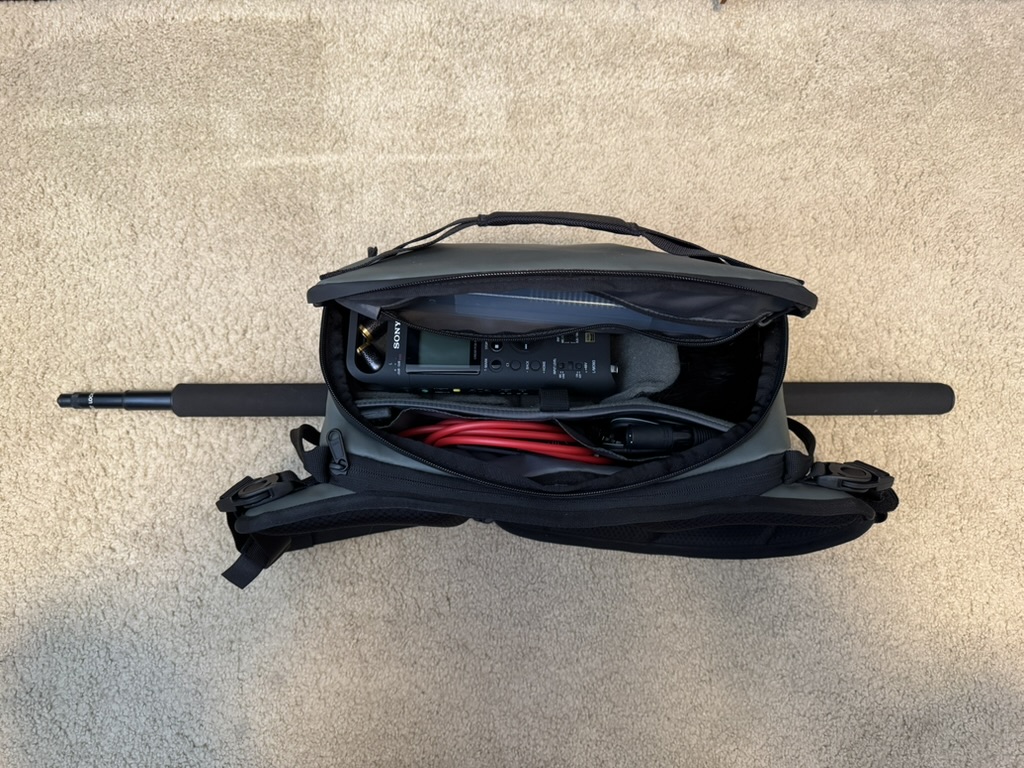
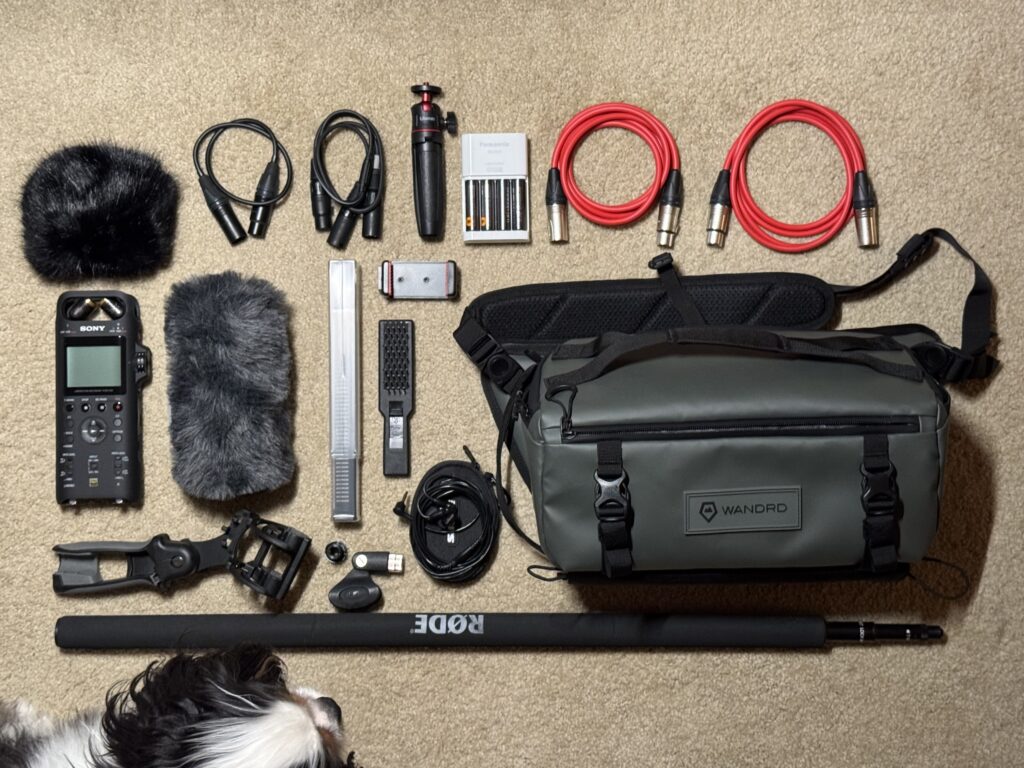
I opted to not go for an Orca bag, because packing in it the Sony PCM-D10 Portable Recorder that I have didn’t make a lot of sense. In other words, it was too much bag for the content (not to mention the price of an average Orca bag).
If I get something like a Sound Devices MixPre 6, then that’s another conversation. But I have the Sony and it’s great; no 32 bit floating… just up to 24 bit, and at 96KHz, and sounds amazing. That said, 32 bit floating would be nice to have, just to help me out with extreme dynamics. But for now it’s good old level setting, and a limiter on the recorder. Maybe I’ll get something like a Zoom F3 Field Recorder, but I’d be losing the built in mics… thought for another day.
Additionally, I got a Rycote Classic Softie with Lyre Mount and Pistol-Grip Kit to deal with wind outdoors.
Luckily I already had a shotgun mic: an Audio-Tecnica BP4029, which I acquired over 10 years ago. It’s interesting that it is a stereo shotgun mic, which I think it was initially designed for broadcast audio. I’ve used it before to record live audiences, and it works pretty well. But I feel like I’m ultimately going to get something like a Rode NTG-3… actually, probably the NTG-3. Just a solid, single channel, workhorse mic that I’ve used before, and really like. Or I could shoot up to a Sennheiser MKH 416; who knows, maybe, but probably not.
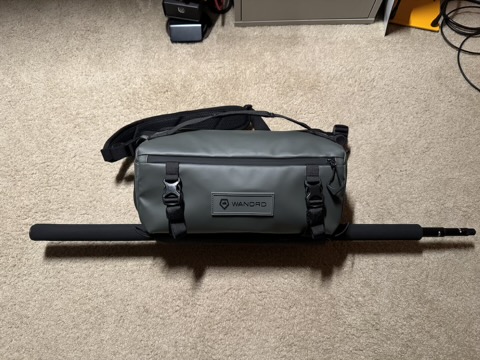
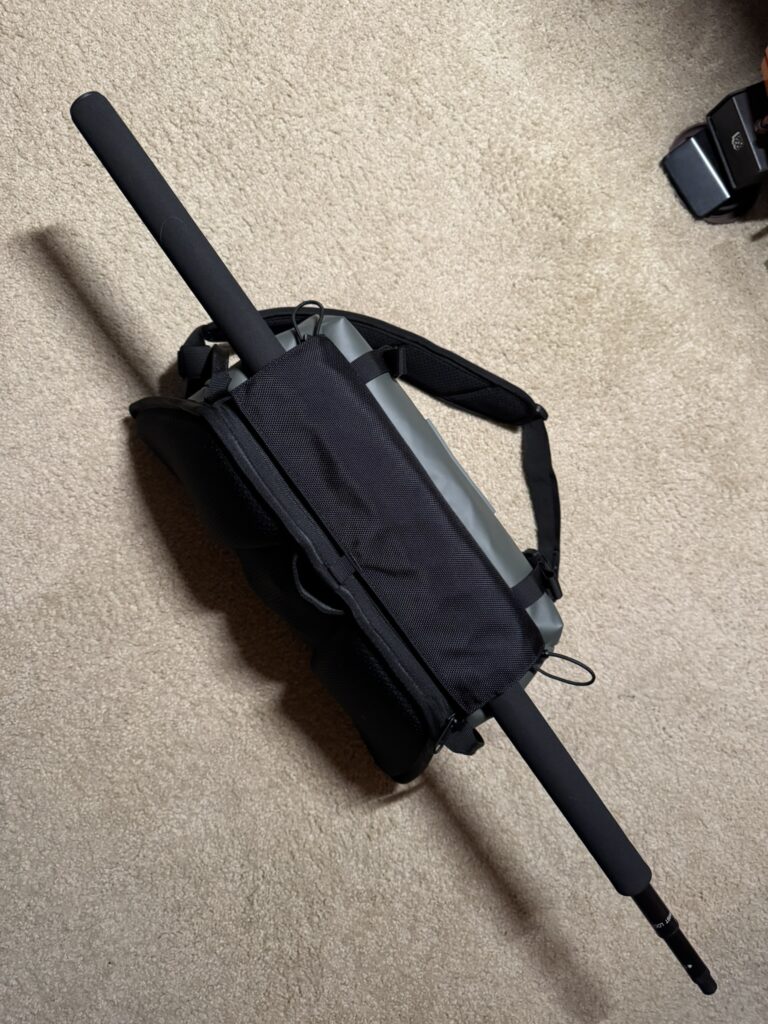
Going back to the bag, it was kind of a recent find… It was super important to the design of the kit that the bag was to be sling style that I can wear on my back, or my waist with everything in it while I’m recording. So, the mic cables are coming out from the top of the bag, connected to the mic in my hand; or both if I’m using the boom pole.
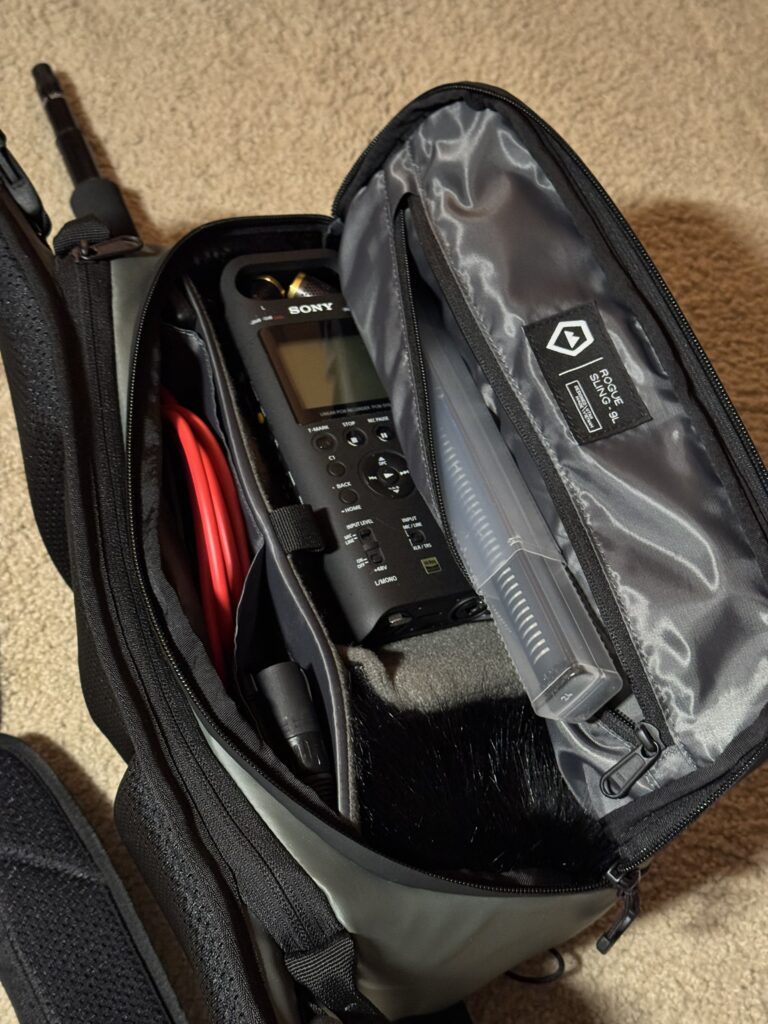
It’s a camera bag made by a company called Wandrd. It’s a Rogue 9L Sling V1 in Wasatch Green, and it’s pretty great. I managed to just fit everything in it:
- Sony PCM-D10 portable recorder
- The Rycote dead cat with pistol grip mount.
- Two 10′ XLR cables I built.
- The proprietary Y cable for the BT4029
- The short XLR jumper cable that came with the pistol grip kit
- A tiny tripod incase I want to use the D10 built in mics to record without me handling it and print a noisy mess to memory. Built-in mini selfie stick and phone clamp included… nice!
- A short, super portable Rode Boom Pole that extends up to 6 ft 3/4 in, and shrinks to about 3 ft. I found that it can be hooked up to one of the exterior holds of the bag for transport; like a camera tripod would.
- An extra wind fuzzy for the PCM-D10’s built in mics, which is replacing the foam wind screen that the D10 came with.
- a set of eneloop rechargeable batteries (the pro version) and the charging dock for them.
- AT BT4029 mic in a clever mic tube from Rycote
- A set of Shure SE215 PRO Wired Earbuds. Not enough space for cans.
- and an extra set of eneloop pro rechargeable batteries.
And that’s pretty much it. Designed to be a field recording go-bag that I’m pretty excited about.
There will be some updates on locations captured in future posts.